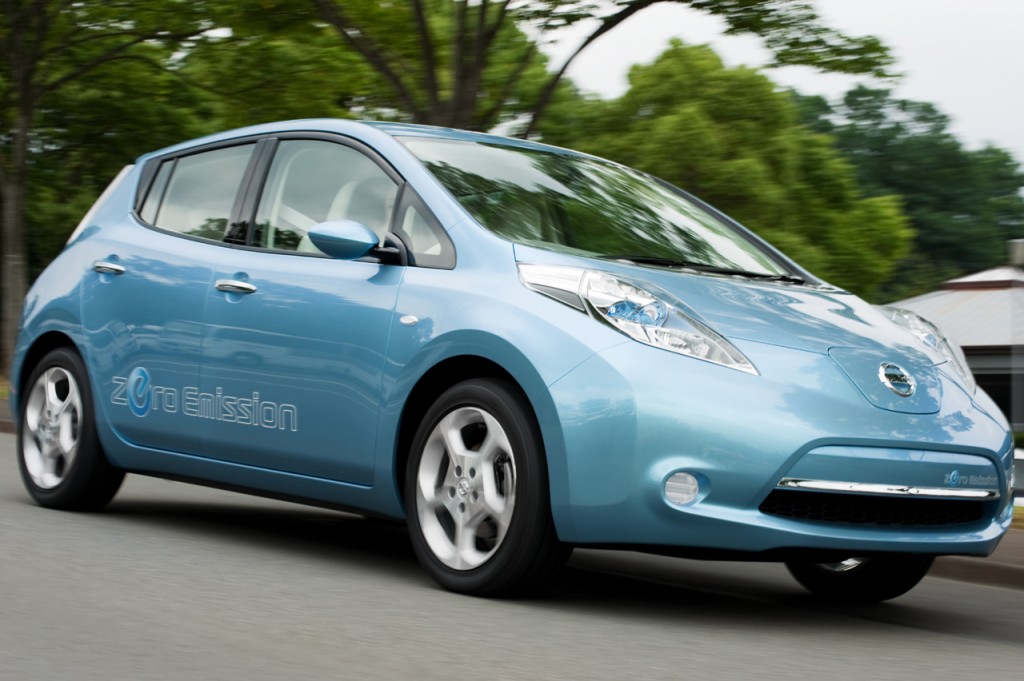
Preview: 2012 Nissan Leaf
Graeme Fletcher for National Post
Nissan's Leaf has a 160-kilometre range.
Graeme Fletcher, National Post · Thursday, Oct. 21, 2010
NASHVILLE . The future of the automotive industry is going to be
electric -
be it a plug-in hybrid, an extended-range car such as the Volt or a
full-on
electric vehicle. However, depending upon the source, how quickly the
world
will change is open for debate.
Some suggest the day of the all-electric car is so far out I'll be pushing
up daisies before it dawns. Nissan, however, thinks the time for an
electric
car is now (the fall of 2011 in Canada). Welcome to the Leaf.
At the heart of this attractive hatchback is the main 24-kilowatt-hour
lithium-ion battery that sits beneath the floor. The placement does a
couple
of good things. First, it does not eat into the interior space, although
the
on-board charger does put a crimp in the trunk's functionality. More
importantly, the low placement keeps the centre of gravity down, which
helps
the handling - the Leaf is comfortable and surprisingly sporty. Body roll
is
minimal and there's only a mild bout of understeer when the P205/55R16
tires
are pushed toward the limit.
The main battery can be recharged using a regular 110-volt outlet.
However,
this method leaves the vehicle in dry dock for an agonizingly long 20
hours.
Plugging it into a 220-volt outlet (the same power supply demanded by an
electric stove or dryer) drops the charge time to less than eight hours,
which is far more realistic. Ultimately, the best solution lies in a
special
fast-charging system that's capable of instilling an 80% charge in less
than
30 minutes. Better yet, it has a "splash-and-go" feature that puts enough
energy into the battery to extend the Leaf's driving range by 50
kilometres
in just 10 minutes. Unfortunately, the cost of this three-phase charging
system is, at this juncture, prohibitively expensive.
The battery powers an 80-kW electric motor that sits under the hood. In an
interesting twist, the motor and its power electronics have been fashioned
such that the unit looks like a conventional engine - go figure. Anyway,
the
electric motor produces some pretty impressive numbers - 107 horsepower
and,
more importantly, 208 pound-feet of torque from Rev One. This gives the
perky hatch plenty of pop off the line and good mid-range response.
Impromptu testing pegged the zero-to-100-km/h time at 10.4 seconds and the
more important passing move - 80-to-120-km/h - at a brisk 7.7 seconds. It
also has the wherewithal to deliver a claimed top speed of 145 km/h.
The Leaf delivers a very respectable range of 160 km per charge. There are
two driving modes - normal and economy. The latter softens the throttle
response, cuts the air conditioner's run time and increases the
aggressiveness of the regenerative braking. Switching from normal to
economy
on the drive route saw the distance to empty rise by about 10%, which
speaks
to the importance of being easy on the accelerator pedal. It works so
well,
in fact, that it is the preferred mode for the majority of the time. The
softer throttle does slow the pickup rate noticeably, but not to the point
where it's a pain. Besides, if the driver needs passing power, hammering
the
pedal sees the electric motor automatically resume its normal (speedier)
work ethic.
The other bit of good news is that the electric power does not diminish
the
Leaf's lengthy list of equipment. The base SV features everything from the
desirable power toys and cruise control to a good navigation system as
well
as push-button start, a heated steering wheel and heated front seats. The
up-level SL adds a backup camera, fog lights, HomeLink, a cargo cover and
a
solar panel that charges the secondary 12-volt battery (it powers the
likes
of the audio system). The materials are also very good, and this includes
the seat fabric - it is made from recycled pop bottles.
One of the cool features is something called Carwings. It's a clever
extension that keeps the driver up to speed via a smartphone. For example,
it sends an email to update the owner about the vehicle's state of charge
and it allows the cabin to be pre-warmed or pre-cooled while the car is
plugged into the power grid. The latter is an important part of the range
equation, as it removes an onerous burden from the main battery. The other
neat trick is a button on the navigation system that displays the Leaf's
effective driving range and the location of charging stations. It's all
heady stuff.
The Leaf is a remarkably well-integrated automobile that really does
showcase how good the electric car can be when it's done properly. Unlike
so
many hybrid vehicles, the Leaf's regenerative braking is unobtrusive, the
steering has some real feel to it and the performance is decidedly perky.
The irony is that after spending billions engineering noise out of the
modern automobile, the Leaf has some built into it - a discreet noise that
warns pedestrians of the Leaf's presence. This is needed, as the Leaf is
basically silent.
Pricing has yet to be announced; however, it will likely start around
$35,000. In Ontario, there is an $8,500 government incentive given to
those
who buy this electrified ride, which will drop the Leaf's purchase price
from costly to realistic. Quebec is the only other province to offer a
similar ($8,000) incentive.